Chapter 49
What does a good SSP version history and change log look like?
Your assessor opens your SSP and asks one quiet question: is this plan still true?
SSP means System Security Plan. CMMC means Cybersecurity Maturity Model Certification. CUI means Controlled Unclassified Information. POA&M means Plan of Action and Milestones. CFR means Code of Federal Regulations. OSCAL means Open Security Controls Assessment Language. SAR means Security Assessment Report.
The version table is your answer
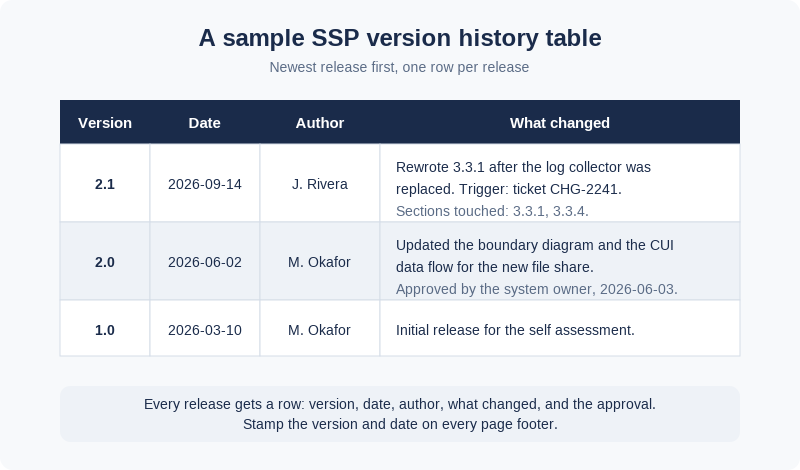
The first page after the cover should carry a version history table. It lists every released version, newest first. Each row holds the version number, the release date, the author, and a short note on what changed. An approval name and date close out each release. NIST's system plan guide treats the plan as a maintained record of decisions NIST SP 800-18r2.
Stamp the version and date on every page footer. Keep one copy in one place as the version of record. When a change ships, issue a new version number. Never overwrite the history of an old release.
What each entry must contain
A good entry answers four questions. What changed. Why it changed. Who made the change. When it shipped. The diagram above shows a clean example.
Name the sections you touched, so an assessor can jump straight to them. Name the trigger: a change ticket number, an incident, a new tool, a POA&M item closing.
A bad entry hides the facts. "Updated controls" says nothing. "Rewrote 3.3.1 to name the new log collector after the syslog server was replaced in March" says everything.
Record reviews too, even when nothing changed. "Reviewed, no changes required" with a date and a name proves active maintenance. That is what "periodically update" means in NIST SP 800-171 Rev 2 NIST SP 800-171 Rev 2. The requirement text is:
Develop, document, and periodically update your system security plans. They must describe system boundaries and operating environments. They must show how you implement each security requirement. They must show relationships and connections to other systems.
Keep every prior version retrievable, dated and named. An assessor may ask which version matched a past self assessment. If you cannot produce it, your history is only a claim.
How the log ties to POA&M and re-verification
A POA&M tracks gaps that need fixing. The version history tracks the document keeping up with those fixes. When a POA&M item closes, the SSP earns a new version entry. That entry names the updated control description and the evidence behind it. The two documents move in lockstep.
This matters because the SSP carries unusual weight in the CMMC rule. A plan of action can never cover requirement CA.L2-3.12.4, the System Security Plan itself 32 CFR 170.21. The rule also says an SSP must be in place at assessment time. It covers every system in scope 32 CFR 170.24. No SSP, no assessment. A thin version history tells the assessor the plan was written for the assessment and then frozen.
After remediation, controls are re-verified against the updated plan. The version history records which version the re-verification tested. That closes the loop: POA&M item, SSP update, new version, verification.
What assessors check
Assessors do not grade the beauty of your table. They check three things. First, the version date must match the environment they see, not a snapshot from last year. Second, the change log must show ongoing maintenance, not a single 1.0 from the kickoff meeting. Third, entries must tie to real activity: change tickets, incident reports, POA&M items, tool rollouts.
Vague entries invite questions. "Various updates" tells an assessor nothing. Specific entries with dates, names, and section references end the questions fast.
One more habit: keep the log machine-friendly
NIST's system plan guide now expects plans to be maintained through monitoring and event-driven review. No more one annual rewrite NIST SP 800-18r2. NIST's OSCAL format for security plans builds version history into the file itself. It uses a list of revision records OSCAL SSP model. Even if your SSP is a document today, a clean structured log makes the machine-readable move painless later.
Sources
- NIST SP 800-171 Rev 2: Protecting CUI in Nonfederal Systems and Organizations
- NIST SP 800-18r2: Developing Security, Privacy, and Cybersecurity Supply Chain Risk Management Plans for Systems
- OSCAL System Security Plan model reference, revision history element
- 32 CFR 170.21: Plan of Action and Milestones requirements
- 32 CFR 170.24: CMMC scoring methodology and SSP assessment requirement
- 32 CFR Part 170: CMMC Program rule
Next step
PolicyCortex generates SSP, SAR, and POA&M output from live Azure configuration evidence, and re-verifies after remediation: PolicyCortex.