Chapter 53
Your SSP Inventory Must Name the Firewall, the Mail Gateway, and the Backup Server
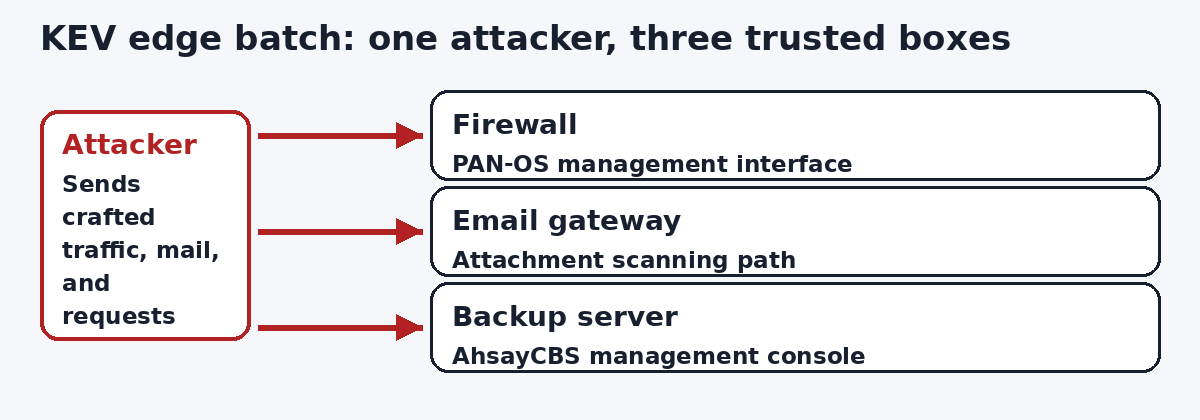
A System Security Plan (SSP) starts with an honest inventory. If an appliance protects the system, the plan must name it. If an appliance stores system data, the plan must name it too.
Four exploited flaws now test that inventory habit. The Cybersecurity and Infrastructure Security Agency (CISA) added them on October 14, 2026. They joined the Known Exploited Vulnerabilities (KEV) catalog with active exploitation evidence.
Three inventory lines to check today
First, the firewall line in your inventory. CVE-2026-0322 reaches root in the PAN-OS management interface. Your line should name the model, the build, and the owner. It should also say who can reach that management interface.
Second, the email gateway line in your inventory. CVE-2026-76519 reaches root in Cisco Secure Email Gateway. One crafted attachment is the whole attack path. Your line should record the Content Scanner Tools version too.
Third, the backup server line in your inventory. CVE-2026-105133 and CVE-2026-105134 chain inside Ahsay AhsayCBS. That chain ends with SYSTEM access on the server. Your line should name its console exposure and stored data.
Why version detail belongs in the plan
Many plans list a product name and nothing more. That level of detail cannot support a flaw response. Nobody can tell exposure from a product name alone. The Ahsay case proves the point in public.
Ahsay shipped earlier patches that left both flaws open. Only hotfix 10.3.4.45 fully addresses them for version 10. Version 7 through 9 systems need hotfix 9.15.2.70 instead. An inventory without build numbers hides that difference completely.
The Common Vulnerability Scoring System (CVSS) scores underline the stakes. The Cisco flaw scores 9.8, and the Ahsay command flaw scores 9.3. The PAN-OS flaw scores 8.6 in the same batch.
Keeping the plan alive after patch day
Update the inventory line when the build changes. Attach the patch date to that same line. Add the compromise check result beside it. Then note the entry in your plan change log.
An assessor reads those updates as control maturity. A stale plan tells a different story entirely. It says the boundary description stopped matching reality months ago.
PolicyCortex does not patch these appliances. Your team applies each vendor fix and updates the plan. PolicyCortex helps keep plan evidence linked to live systems.
What to do this week
Open the inventory section of your SSP. Find the firewall, gateway, and backup server lines. Add missing builds, owners, and exposure notes today. Create any missing line before your next assessment touchpoint.
Sources
- CISA alert, CISA Adds Four Known Exploited Vulnerabilities to Catalog, October 14, 2026. https://www.cisa.gov/news-events/alerts/2026/10/14/cisa-adds-four-known-exploited-vulnerabilities-catalog
- CVE-2026-0322 record, CVE Program. Palo Alto Networks advisory at https://security.paloaltonetworks.com/CVE-2026-0322
- CVE-2026-76519 record, CVE Program. Cisco advisory cisco-sa-esa-afw-zqYJkjxp.
- CVE-2026-105133 and CVE-2026-105134 records, CVE Program. Huntress report at https://www.huntress.com/blog/ahsaycbs-flaws-exploit
- Original diagram by PolicyCortex.
Next step
Want SSP inventory lines that stay tied to live system data? See how PolicyCortex keeps the plan current.