Chapter 52
How do I keep the SSP a living document?
Your SSP describes last quarter's environment. Your network changed since then. That gap is what assessors look for first.
SSP means System Security Plan. CMMC means Cybersecurity Maturity Model Certification. CUI means Controlled Unclassified Information. ISSO means Information System Security Officer. POA&M means Plan of Action and Milestones. DoD means Department of Defense.
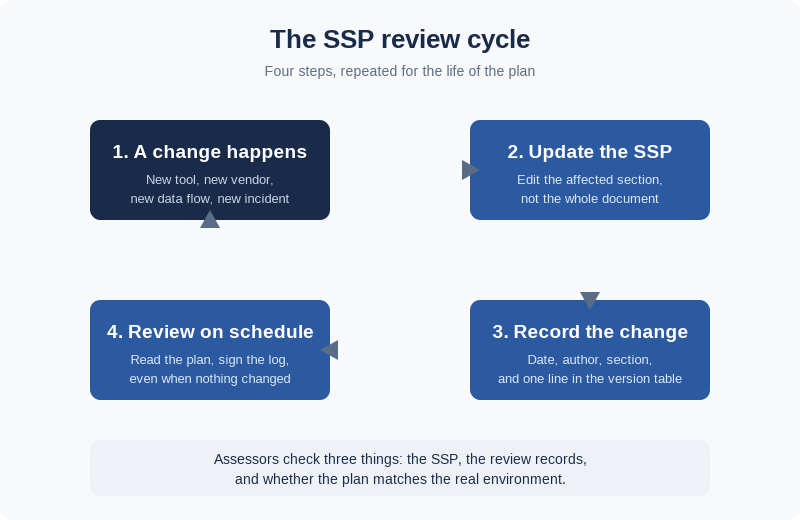
Write the update rule into the SSP itself
The CMMC assessment checks two things about currency. First, that your SSP states how often it gets updated. Second, that you actually did it on that schedule. (CMMC Assessment Guide, Level 2)
Put one short section in the SSP. It names who reviews it, how often, and what triggers an off-schedule update. The CMMC guide says the defined frequency must be at least annually. That sentence is your proof of habit.
Name one owner
A living document has one person in charge. Most small contractors make the ISSO the owner. The owner does not do every edit. The owner makes sure every edit happens.
Write the owner's name in the SSP. When the owner changes, update that page the same day. Assessors interview the people named in the plan. (NIST SP 800-171A)
Keep a change record, not a rewrite
You do not rewrite the SSP every month. You record what changed. Add a version table at the front. It lists the date, the author, the section touched, and one line describing the change.
Assessors ask to see records of system security plan reviews and updates. That exact phrase is in the assessment guide. A version table plus dated approvals satisfies it.
NIST guidance also says the SSP does not have to be one file. It can be a set of documents that point to each other. (NIST SP 800-171 Rev 2) Let control narratives reference the real policy and procedure documents. Then a tool change means one procedure edit and one SSP line, not a full rewrite.
Tie updates to your change process
Most environments already have a change process. That means tickets, change requests, and vendor contracts. The SSP owner should review that queue every month. Ask one question each time: does this change the SSP?
Examples include a new firewall, a new cloud service, a new CUI data flow, or changed vendor responsibilities. Each of these needs an SSP edit within days, not at the next annual review. Make the SSP a checkbox on the change ticket template.
Review on schedule even when nothing changed
If the monthly queue shows no changes, the quarterly review still happens. The reviewer opens the SSP, reads the boundary and control narratives, and signs the review log. No changes is still a recorded review.
This matters on assessment day. The absence of an up-to-date SSP can end the assessment with a finding of incomplete information. (CMMC Assessment Guide, Level 2) A review log with recent dates shows the plan was alive before the assessor arrived.
Close the loop with the POA&M
When a POA&M item closes, the SSP changes too. The control narrative must describe the new implementation, not the old gap. When a new gap opens, note it in the SSP as scheduled for implementation with its date.
The POA&M and the SSP tell one story. Assessors read both.
What assessors check for currency
Assessors examine your security planning policy, your review procedures, the SSP, and the records of reviews and updates. They interview the people responsible. They test whether your review and update process actually runs.
Then they compare the SSP against what they see in the environment. The SSP may miss a server they find. A tool may have changed last spring with no version entry. These are the mismatches that fail practices.
Next step
PolicyCortex generates SSP and POA&M output from live Azure configuration evidence, so your plan matches the environment it describes: PolicyCortex.