Chapter 44
How Do I Cover Subcontractors in the SSP?
Your prime contract is covered, but a subcontractor holds the same sensitive data.
SSP means System Security Plan. CMMC means Cybersecurity Maturity Model Certification. CUI means Controlled Unclassified Information. DFARS means Defense Federal Acquisition Regulation Supplement. NIST means National Institute of Standards and Technology. POA&M means Plan of Action and Milestones.
Start with the data, not the company list
List the data first. Name each type of CUI a subcontractor touches. Name where that data flows. Name where it is stored. A subcontractor with no CUI needs no SSP section. A subcontractor with CUI needs a full section.
Draw the flow for each subcontractor. Show data leaving your boundary. Show data entering their system. Show data returning to you. If you cannot draw the flow, you do not know the risk yet.
DFARS clause 252.204-7012 requires flow-down in subcontracts that involve covered defense information. The clause must be included in those subcontracts. That rule is in DFARS 252.204-7012.
Give each subcontractor its own SSP section
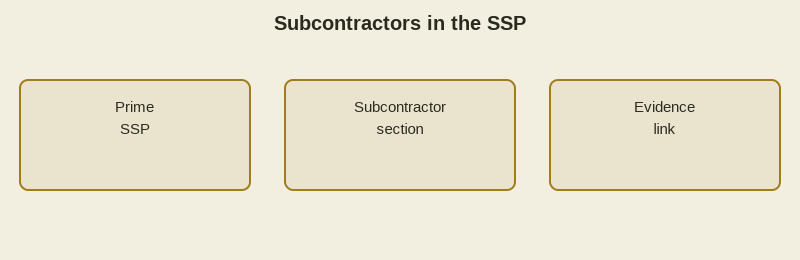
Do not bury subcontractors in one vague paragraph. Give each subcontractor a section. Use the same five fields for each one.
Field one is the company and the contact. Field two is the data it touches. Field three is the systems it uses. Field four is the safeguards it runs. Field five is the evidence you hold.
Keep each section short. Two paragraphs per subcontractor is enough for most cases. A long section hides the key facts. A short section makes review fast.
State the safeguards in plain words
For each subcontractor, state the safeguards it must meet. Use the NIST requirements as the base. NIST SP 800-171 Revision 2 lists the requirements for protecting CUI in nonfederal systems.
Name the safeguards that matter most for that subcontractor. Access control matters for a firm that logs into your system. Media protection matters for a firm that receives files. Incident response matters for every firm that holds CUI.
Do not copy your whole safeguard list into each section. Tailor the list to the data and the work. A tailored list is easier to check. It is also easier for the subcontractor to follow.
Record the flow-down in the SSP
The SSP must show that the clause reached the subcontractor. Note the subcontract date. Note the clause number. Note any added terms you required.
Keep the signed subcontract behind the SSP. Cite its date in the SSP section. If a subcontractor refuses a term, note that fact. Note the risk decision and the approver. A hidden refusal becomes a finding later.
Collect evidence, not just promises
A subcontractor promise is not evidence. Ask for dated records each quarter. Access reviews, patch records, and training lists are good starts. Match each record to a safeguard in the section.
Review the records yourself. Check the dates. Check the names. Check that the record matches the system named in the SSP. If a record is missing, add a POA&M item. Name the owner and the due date.
Update the section when work changes
Subcontractor work changes often. New staff join. New tools appear. New data types arrive. Update the SSP section when any of these change.
Remove subcontractors who no longer hold CUI. Keep their old section in the prior SSP version. An assessor may ask about past data handling. A dated prior version answers that question.
Review all subcontractor sections twice a year. Confirm each firm still holds the data named. Confirm each safeguard still applies. Confirm each evidence record is current. That review keeps the SSP true.
Next step
PolicyCortex collects evidence from live Azure configuration with 33 collectors. The collectors read conditional access, diagnostic settings, Defender posture, backup, and firewall. The evidence is evaluated against NIST 800-53 and NIST 800-171. That evidence supports re-verification after remediation. SAR means Security Assessment Report. It generates SSP, SAR, and POA&M output from collected evidence. AWS means Amazon Web Services. PolicyCortex is strongest in commercial Azure, and AWS is covered. Start at policycortex.com.
Sources
- DFARS 252.204-7012, Safeguarding Covered Defense Information and Cyber Incident Reporting. https://www.acquisition.gov/dfars/252.204-7012-safeguarding-covered-defense-information-and-cyber-incident-reporting
- NIST SP 800-171 Revision 2, Protecting Controlled Unclassified Information in Nonfederal Systems and Organizations. https://doi.org/10.6028/NIST.SP.800-171r2
- 32 CFR Part 170, Cybersecurity Maturity Model Certification Program. https://www.ecfr.gov/current/title-32/subtitle-A/chapter-I/subchapter-G/part-170
- Diagram: original by blog.systemsecurityplancmmc.com.