Chapter 5
GPUStack Auth Bypass: SSP Component Inventory and POA&M Update
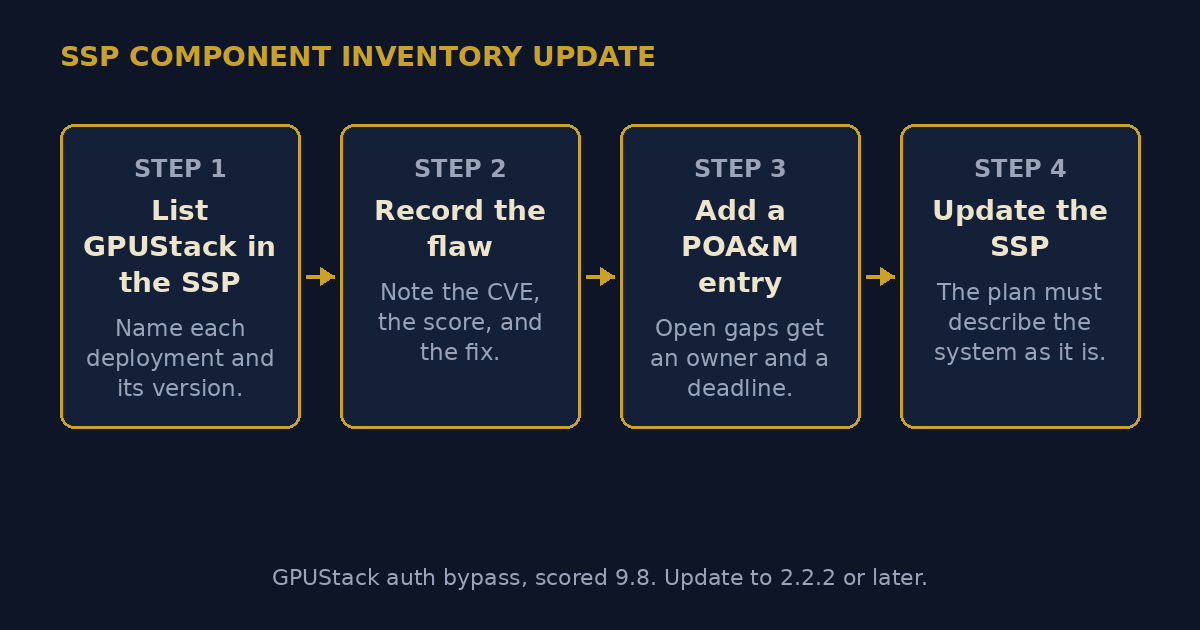
A System Security Plan (SSP) must list what the system really runs. GPUStack is easy to miss. It serves AI models on GPU hosts. It may sit at the edge of the plan. A flaw scored 9.8 was used in the wild. If GPUStack is not in the SSP, the plan is wrong.
The flaw in plain words
The record is CVE-2026-102895. Common Vulnerabilities and Exposures (CVE) is the public record system for flaws. GitHub, Inc. scored it 9.8. The score uses Common Vulnerability Scoring System (CVSS) version 3.1. All builds before 2.2.0 are affected. Version 2.2.0 fixed the flaw.
GPUStack is an open source GPU cluster manager. It serves AI models and provisions GPU instances. Its login code treated a loopback request as the built in admin. The code is in gpustack/api/auth.py. A function named get_current_user made the check. It trusted local traffic when force_auth_localhost was false. False was the default. A remote request could appear to come from 127.0.0.1. The client_ip_getter code accepted a same host reverse proxy peer. It also accepted a client supplied X-GPUStack-Real-IP loopback value.
No login was needed for admin access. An attacker could change users and models. An attacker could create a lasting admin API key. An attacker could read worker and cloud provider secrets. An attacker could run code through POST /v2/inference-backends/from-yaml.
The National Vulnerability Database (NVD) record states the key fact. It says, "Exploitation was observed in the wild against a 2.1.1 deployment". SecurityOnline reported on November 5, 2026 that researcher Javier Sixto of ulex.fr reported active attacks. Intruders used custom backends for reverse shells on worker hosts.
What to update in the SSP
First, add GPUStack to the component inventory. Name each deployment. Give its host, its version, and its role. Note the workers it manages. Note the reverse proxies in front of it. Note the cloud accounts it can reach. A component with no version is not inventoried. It is guessed at.
Second, record the flaw in the plan. Note the CVE record, the score, and the affected versions. Note the fix version. The target is 2.2.2 or later. That version also fixes a sibling flaw. The record is CVE-2026-102894. It scores 9.1. Its SAML callback trusted an unverified SAMLResponse. Security Assertion Markup Language (SAML) is a login standard for single sign on. That flaw allowed auth bypass and account takeover. Version 2.2.2 fixed it.
Third, open a Plan of Action and Milestones (POA&M) entry for each gap. POA&M is the tracker for open gaps. Give each entry an owner and a due date. Keep the entry open until the test proves the fix. The test is a remote request with no login. It must fail to gain admin access. Keep the test date and result with the entry.
Fourth, record the hunt and the rotation. Check for new admin users and keys. Check for new inference backends. Check worker hosts for odd processes. Rotate worker and cloud secrets that may have been read. The SSP must describe the system as it is after the fix. A plan that still lists the old version is stale.
PolicyCortex does not patch GPUStack. PolicyCortex helps teams link proof to requirements.
Sources
- CVE-2026-102895 record, CVE Program. Auth bypass in GPUStack, fixed in 2.2.0.
- National Vulnerability Database (NVD) record for CVE-2026-102895. Score 9.8 from GitHub as CNA. Exploitation observed in the wild against a 2.1.1 deployment.
- GitHub security advisory GHSA-gj9m-f8ph-pmhr. https://github.com/gpustack/gpustack/security/advisories/GHSA-gj9m-f8ph-pmhr
- GPUStack release 2.2.0. https://github.com/gpustack/gpustack/releases/tag/v2.2.0
- CVE-2026-102894 record, CVE Program. SAML callback flaw, fixed in 2.2.2.
- SecurityOnline coverage, November 5, 2026. It reports active attacks found by researcher Javier Sixto of ulex.fr. Intruders used custom backends for reverse shells on worker hosts.
- Original diagram by PolicyCortex.
Next step
Add every GPUStack deployment to the SSP inventory. Update each one to 2.2.2 or later. Open a POA&M entry.