Chapter 25
Cisco Firewall Flaw: What It Means for Your System Security Plan
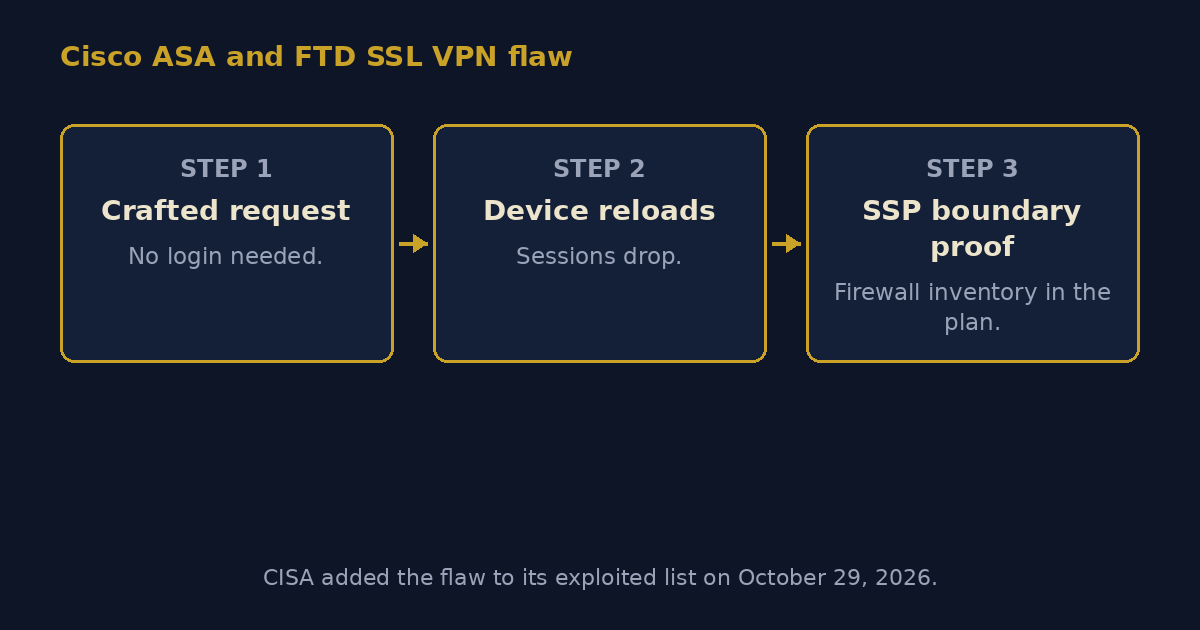
A System Security Plan (SSP) describes the boundary. A new exploited flaw in a boundary firewall tests that description. Update the plan with facts, not general words.
The flaw in plain words
Cisco published a security advisory on October 28, 2026. The advisory covers a flaw in the Remote Access SSL VPN service. The service runs on Cisco Secure Firewall Adaptive Security Appliance (ASA) Software. It also runs on Cisco Secure Firewall Threat Defense (FTD) Software.
The record is CVE-2026-76418. Common Vulnerabilities and Exposures (CVE) is the record system for public flaws. The score is 8.6 under Common Vulnerability Scoring System (CVSS). An unauthenticated attacker can force a vulnerable device to reload. Unauthenticated means the attacker needs no login first. The result is a denial of service. Sessions drop until the device returns.
The Cybersecurity and Infrastructure Security Agency added CVE-2026-76418 to its Known Exploited Vulnerabilities (KEV) Catalog on October 29, 2026. The catalog sets a November 1, 2026 due date for federal civilian agencies.
What is not reported
Cisco reports no confirmed data theft for this flaw. Cisco reports no remote code execution for this flaw. Remote code execution means running attacker code on the device. The confirmed impact is the crash itself, not a takeover. The plan should state that limit plainly. A plan that overstates impact loses trust fast.
What the plan update must show
First, the boundary inventory, with each ASA and FTD device named and its running release listed. Second, the advisory entry, with the publication date of October 28, 2026. Third, the exposure check for each device: SSL VPN reachable, and secondary authentication set on any tunnel group. Check the default tunnel group too. Fourth, the fixed release for each device after the patch. Fifth, the patch date and the scan result after the patch.
A device is exposed only when three conditions all hold. It runs a vulnerable release. Its SSL VPN login service is reachable. Secondary authentication is set in the tunnel group scope. A device that fails any one condition stays in the plan as checked and cleared. That note keeps the boundary description honest.
PolicyCortex does not patch Cisco devices. PolicyCortex helps teams link proof to requirements.
Sources
- CVE-2026-76418 record, CVE Program, score 8.6
- National Vulnerability Database (NVD) record for CVE-2026-76418
- Cisco security advisory, published October 28, 2026
- CISA alert, CISA Adds Two Known Exploited Vulnerabilities to Catalog, October 29, 2026
- Original diagram by PolicyCortex
Next step
Update the boundary inventory in your plan with the fixed release for each device.